Many businesses have gas cylinders stored, and used, within production and other areas but the labelling of gas cylinders is often less understood. Each cylinder comes with its own markings and these are a valuable source of information, these are required by the Carriage of Dangerous Goods and Use of Transportable Pressure Equipment Regulations 2009. The BCGA (British Compressed Gases Association) has recently published updated guidance to help us all more clearly understand the labels.
Important: Please note that we do not provide advice on this issue unless you are a retained client under our Safety~net support scheme. if you’d like to explore the benefits of membership please contact us or request a callback.
A copy of the sheet can be downloaded from the BCGA website here: BCGA guidance TIS6 Labelling of Gas cylinders Please note that the system is not mandatory but is widely adopted in industry, notable exceptions being cylinders containing liquefied petroleum gas, e.g. butane and propane.
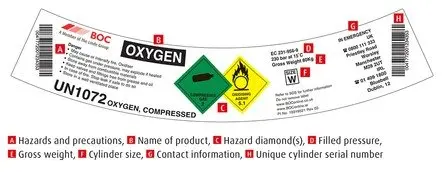
Each label includes up to eleven pieces of information, e.g. the contents of the cylinder, the hazards associated with the product and contact details for the company that supplied it. The BCGA guidance explains how different colours are applied to the shoulder and top of the cylinder to denote other classes of gas, e.g. inert, flammable, oxidising and, in some cases, specific gases. For example, an oxygen cylinder is white at the top, helium is brown, nitrogen is black and argon is dark green.
The colour of the gas cylinder body (as opposed to the top) does not signify anything and depends on the manufacturer’s preference. But there is an exception to this rule which affects acetylene. In the UK it is a legal requirement to paint the whole cylinder maroon. This is due to acetylene being an extreme fire hazard and a consistent colour code ensures they are quickly identifiable by the Fire & Rescue Service in an emergency situation.
Below we can see the European system, EN 1089-3, which has replaced the old cylinder colour scheme (BS349), is to help improve safety standards within the gases industry:
 Here is the BOC adaptation of the system as suppliers are allowed to make some variations as long as they comply with the essential requirements:
 Below is the cylinder identification label which gives further information:
 Good practice on gas cylinder safety
We’d recommend a simple sheet covering the gases which you commonly use at your goods in point or outside of your gas storage area/cage. For higher-risk applications such as the storage of oxygen and fuel gas cylinders the BCGA even have a model risk assessment on its website which you can review here; BCGA TIS15
If you’ve got questions on the manual handling of these cylinders then you can find out more in the publications section of the BCGA website. If you’d like a safety consultant to run through these risks with you and help create a specific risk assessment within your business then please contact us to chat about how we could help; Call Me Back Request and one of our safety consultants will be in touch the same day. Or please see more information on Industrial, Manufacturing & Construction risk assessment support packages we provide.